Nobody says the same line twice
Something has bothered us about life sims for years: after three playthroughs you know the lines by heart. The waitress says the same sentence she said in 2014. The colleague flirts with the same words whether he is shy, cruel or married to your sister. In The Sims, everyone in town went to the same school of small talk, and it closed long ago.
So we added an option to plug an AI into the game.
How it works
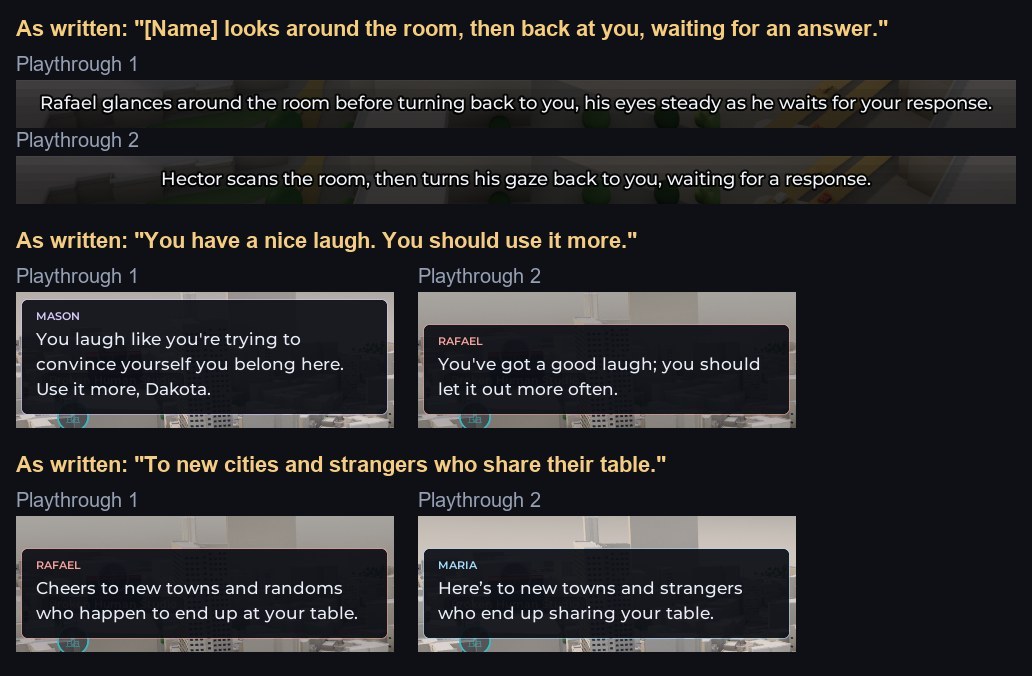
When a scene starts, the game introduces its people to the model, once. You, the person in front of you, their age, their character (shy, hot-headed, romantic, two-faced), and what they are to you: a colleague, an ex, a neighbour, your sister. Then the model writes the scene's lines again, in that person's voice. What happens stays exactly the same: who does what, who pays, who leaves. Only the words change. Play the same scene three times and you get three versions of it, and a stranger no longer talks to you like your boyfriend does.
Your choices are never touched. The buttons you click are the ones we wrote, so the AI can make the dialogue sound right but it cannot decide anything for you.
Your model, your rules
You plug in whatever you want. The best case is a model running on your own graphics card, uncensored: nothing leaves your PC, and nobody filters what your characters say to each other. llama.cpp, KoboldCpp, Ollama and LM Studio each have a button in the settings, and a hosted service works too if you would rather pay someone else's electricity bill.
You pick a writing style: realistic, close to the original, vivid, raw, or literary. If that is not enough, you can open the instructions we give the model and rewrite them yourself. We tested it with a 35-billion-parameter model on one card: a scene is rewritten in a few seconds. Over four playthroughs of the same scene, most lines came out different every time; now and then the model repeats itself or keeps a line almost as we wrote it, and we are tightening that.
It is an option, and it is off unless you turn it on. Without a model, the game plays exactly as before, with our text. If your server dies in the middle of a scene, the scene carries on with the written lines and does not wait for it.
Next: people with ideas of their own
inZOI has AI characters too, and fair play to them for getting there first. Theirs run on a model of half a billion parameters, roughly the vocabulary of a well-read parrot. Their Zois are allowed to want a promotion. We want ours to want things they would never say out loud.
That is the next job. Once a day, the AI rereads what a person has lived through (who betrayed them, who they fancy, what they are hiding, what they owe) and sets what they want: get even, win someone over, leave their partner, make rent by any means. The game then pursues it, with real consequences in the city, weeks later if need be. When someone is in the same room as you, the AI can also pick what they do next, among the things the game allows them to do.
You will decide how far it goes: only the people close to you, a number of people you set, or the whole city. We do not want an AI doing nonsense in a corner either. What it decides, you will see, you will know why, and it will leave marks. It is not done yet, but it has started.
Meanwhile, in the creator
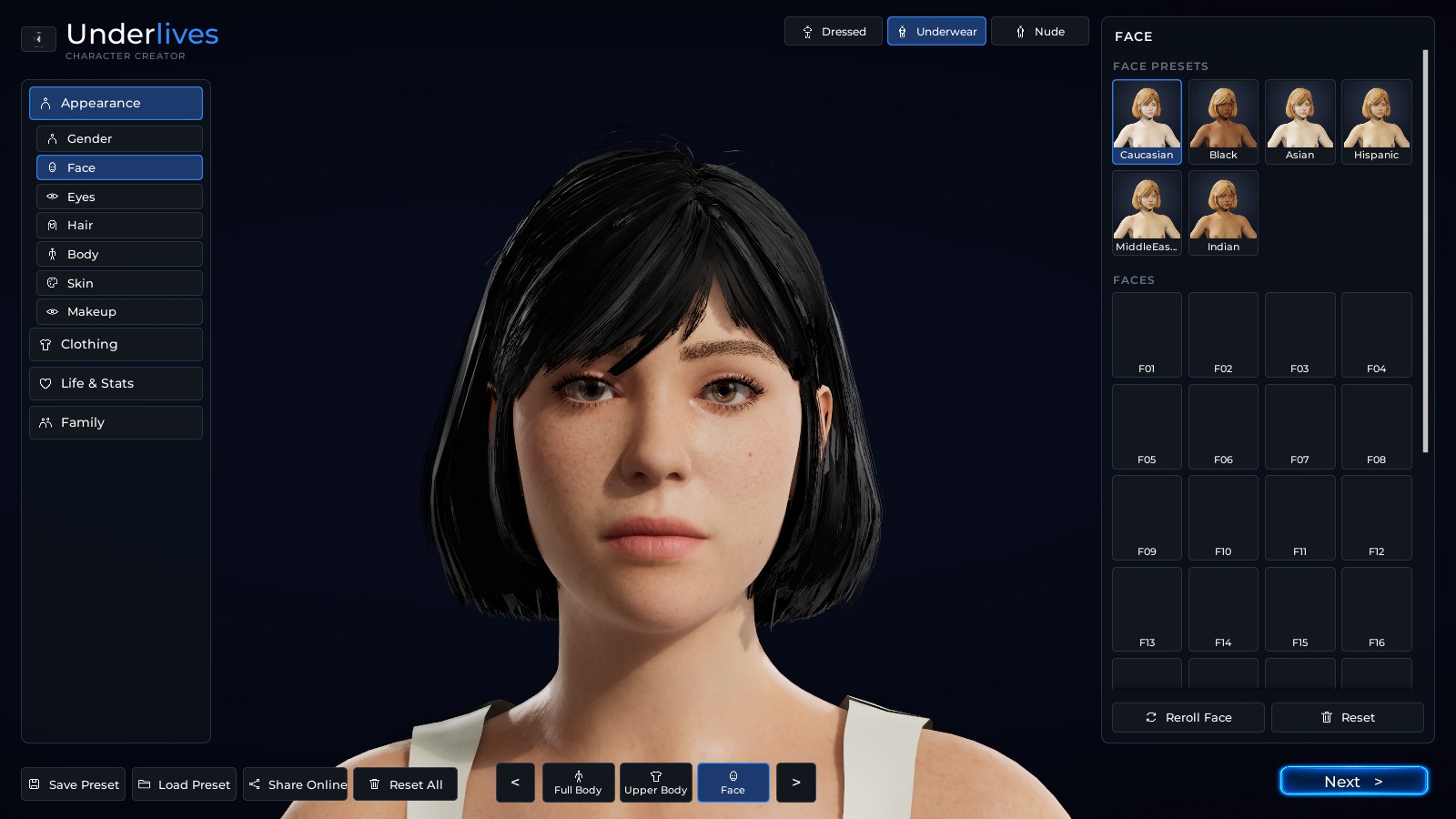
While we were teaching people to talk, the creator changed a lot. It has a real studio now: light from the side so faces have volume, an HDR environment, shadowed rims. Skin has a new subsurface profile, lips are moist, eyes have their wet film back, and the creator renders at full resolution. Faces start from heads of your character's origin instead of one shared face, and the body zones you sculpt show as a soft fill with arrows that tell you what a slider does before you touch it.